Pages

Thursday, 21 April 2011

Being a policeman

By 1900, working as a police constable meant a steady job with low income but attractive benefits. Employment was independent of the business cycle and pay was not linked to individual performance. Such work was in demand and only one-in-five applicants were accepted. In the Metropolitan Police during the nineteenth century, only about 10% of the force was born in London. This reflected the preference of senior officers for country men because they were regarded as healthier, tougher and more willing to take orders and they did not have the conflicting loyalties exhibited by some Londoners who policed their own neighbourhood. Initial recruits to the Metropolitan Police were between the ages of 18 and 35 years but as policing became more attractive recruitment was limited to those between 20 and 27. Most were still labourers though the number of recruits from non-manual backgrounds increased, a process aided by the increasing status of the job and with the provision of pensions from 1890, its job security.[1]

The early constables were usually recruited from the agricultural labour force or from the army, were paid low wages and were often quick to leave the force. Men who left on their own will tended to be from more skilled occupations, with a background of better work before joining the force. In the early twentieth century, though, economic pressures encouraged more of these men to join the force. Veterans tended to be men from unskilled or semi-skilled backgrounds, for whom the police service was an avenue of upward mobility. Although men from poorer backgrounds remained longest in the police, those from better-off backgrounds who did remain were most likely to rise through the system into the higher ranks. Others were dismissed for drunkenness. A parliamentary select committee in 1834 heard that 80% of dismissals were for drunkenness.

Crime 31

Initial formal training was about three to five weeks by 1900 and about half that in 1850. Until the early-twentieth century, most training was military drill for purposes of crowd control, with only brief training dedicated to behaviour on the beat and this was largely remembering laws and instructions.What counted was the informal training learned on the beat and the habits picked up from established officers. Isolated by uniform, discipline and function from the working-class communities and upholding ‘order‘ in the face of chronic hostility and abuse from their targets, career policemen developed a distinct occupational culture with its own values and standards that strengthened bonds between fellow officers. The police generated their own, often discretionary, operational standards on the streets, passed on via ‘apprenticeship’ from officer to officer, that were often less respectable and at odds with those of the rulebooks and the letter of the law.[2]

Some degree of tension between the command structure and the ordinary station-men was endemic in British policing. It stemmed from grievances about working conditions. In 1848 a number of constables petitioned their superiors that their pay was not sufficient to support a family. In 1872, when over 3,000 constables and sergeants turned up for a meeting to discuss demands for a pay rise. Senior officers at Scotland Yard were so concerned that a pay rise was quickly granted but later 109 men involved in the action were sacked. There were abortive Metropolitan Police strikes in 1879 and 1890. In 1890, there was n attempt to form the Metropolitan Police Union, but granting of pensions removed a major source of complaint. Since the police were used against industrial unrest the fact that officers were appropriating the language of trade unionism was viewed as a potential threat to discipline and in conflict with the demands of the job. A further attempt to unionise occurred in September 1913 with the resurrection of the Metropolitan Police Union that the following year changed its name to the National Union of Police & Prison Officers. A police order was issued in December 1913 threatening the dismissal of officers associated with the union.

Crime 32

Bridgnorth Borough Police Force c. 1880

In addition, there was the remoteness of commissioners and chief constables, often trained in the military or colonial services, from the lower-rank notions of ‘good policing’ that focused on detection rather than deterrence, action rather than service, physical engagement rather than administration.[3] There were sporadic campaigns against their corruption and malpractice. These surfaced during the trials of 1877 and of Inspector White in 1880 and during the public disquiet that resulted in the issuing of Judges’ Rules on interrogation and arrest procedures in 1912. The 1906-1908 Royal Commission was initiated over the alleged wrongful arrest of Mme D’Angely, a lady of dubious reputation but a lady nonetheless. In this case, the police made the mistake of doing tactless things to articulate people. [4]

A high number of complaints were brought against the Metropolitan Police in their early years. Between 1831 and 1840, the average number of complaints against the police was 411 per annum. The number of complaints was at its highest, at 511, in 1840. Of these, 273 were made against individual officers; the remainder concerned the small strength of the force and the frequency of robberies. The 1906-1908 Royal Commission upon the Duties of the Metropolitan Police found that only nineteen of the complaints it invited were worth examining and only a few proven satisfactorily. The impoverished public that did not matter but might have known better about police malpractice did not speak out; when it did, hostile questioning discredited it. What is clear from the evidence of the Royal Commission is the long-standing system of wheeling and dealing between police and underworld that had its own unwritten rules and at which command officers had no choice but to connive. Blind eyes were turned, favours exacted and reciprocated, informers employed, bribes exchanged and some brutality was standard practice. Relations between police and law-breakers were necessarily close and it would be surprising then as now, if they were not also contaminating. Witnesses before the 1878 confidential detective committee drew a thin veil over the implications of detectives ‘using’ a certain class of people among the criminal class from whom to get information by small payments or other means. Officials recurrently compromised in their efforts to police the streets.


[1] Martin, John and Gail Wilson, Gail, The Police, A Study in Manpower: Evolution of the Service in England and Wales, 1829-1965, (Heinemann), 1969 and Shpayer-Makov, H., The Making of a Policeman: A Social History of a Labour Force in Metropolitan London, 1829-1914, (Ashgate), 2002.

[2] Taylor, David, ‘The standard of living of career policemen in Victorian England: the evidence of a provincial borough force’, Criminal Justice History, Vol. 12, (1991), pp. 108-131 and Lowe, W.J., ‘The Lancashire Constabulary, 1845-1870: the social and occupational function of a Victorian police force’, Criminal Justice History, Vol. 4, (1983), pp. 41-62.

[3] Wall, David, The Chief Constables of England and Wales: a socio-legal history of a criminal justice elite, (Ashgate), 1998, pp. 13-86.

[4] Clapson, Mark and Emsley, Clive, ‘Street, Beat, and Respectability: The Culture and Self-Image of the Late Victorian and Edwardian Urban Policeman’, Criminal Justice History, Vol. 16, (2002), pp. 107-131.

Monday, 18 April 2011

Extending the police force nationally 1835-1880

Suspicions that the new Metropolitan Police was a covert military force persisted across the political and social spectrum and the question of rising policing costs irritated parish authorities. Widespread complaints of inferior services delivered for higher charges were eventually met in 1833 by central government agreeing to fund a quarter of policing costs. The continuing political sensitivity of the new police led to persistent parliamentary scrutiny. Of particular importance was a Select Committee in 1834, consisting of many of the 1828 Select Committee and Peel, that concluded after looking at statistical evidence that the Metropolitan Police was achieving its objectives and that its

...influence in repressing crime, and the security it has given to person and property [makes it] one of the most valuable modern institutions. [1]

Parliament now turned its attention to policing beyond the metropolis.[2] The Metropolitan Police formed the model for the rest of England and Wales but, despite their early successes, the expansion of police forces to rural areas was gradual. Just as within London, provincial policing raised sensitive issues of local social influence and political power and the structural problems were the same. As a result of extensive local autonomy, there was an enormous variety of structures and degrees of sophistication in rural and urban policing, united principally by their common use of part-time constables and watchmen. The limitations of these diverse systems was highlighted by the agitation against the new Poor Law and the emergence of Chartism and soon the issue was not should a national reformed police system be adopted but what type of system.

As the idea of the new police spread to the provinces, they were often given very wide functions, understandable in terms of very general notions of regulation and inspection.[3] The Acts of 1839 and 1842 that enabled extension of police role and functions in the counties, included collection of rates, road surveying, weights and measures inspection and dealing with vagrants under the Poor Law legislation as legitimate police functions. Carolyn Steedman commented that by

...the 1860s and early 1870s witnessed something like an inspection fever...[with suggestions that] policemen be appointed as inspectors of taxes, of unemployed children not covered by the Factory Acts, of midwives and truants under the educational reforms of the 1870s. Carried away by the vision of a thoroughly policed and inspected society, some, including county chief constables, suggested that the homes of the poor should be inspected by the police for cleanliness and against overcrowding.[4]

Extensive growth in urban manufacturing centres had rendered local government structures generally inadequate.The 1835 Municipal Corporations Act helped older boroughs to sort out their administrative structures and allowed new towns to become incorporated. Towns that were incorporated were obliged to set up a Watch Committee responsible for appointing sufficient paid constables to keep the peace and prevent crime but few of them seemed eager to implement the law. Although, this was mandatory under the legislation, there was a complete lack of any regulations for government policing under the Act, a reflection of an absence of sufficient political support for further erosion of corporate autonomy. As a result, by 1837, only 93 of 171 boroughs had organised a police force; three years later, 108 of 171 boroughs had organised a police force but by 1848, 22 boroughs still had no police force. Municipal forces were about half the size of London, proportionate to population and remained grossly inadequate until after 1856.

Crime 28

Warrington policeman c1860

Rural policing was generally regarded as ineffective and parish constables, uneducated, ignorant of their duties, lazy and corrupt. Rural disturbances in the early 1830s underscored the limitations of rural policing. The Swing Riots in rural southern England, combined with those in urban areas centring on the Reform Bill crisis at the beginning of the 1830s, led the Whig government to prepare a bill setting up a national police system but declining disorder and more pressing legislative priorities killed off this initiative.[5] However, these events, along with rising rates of local vagrancy, coupled with falling levels of social deference, encouraged local reform initiatives. Two approaches were available: private subscription forces, usually established by the local landed interests and action under the Lighting and Watching Act 1833 that gave parish councils powers to levy a special rate to employ sufficient watchmen of day and night. These aimed gently to encourage greater levels of rural policing without challenging local autonomy but the extent to which permissive powers were adopted depended on levels of local anxiety about crime and disorder and a willingness to fund reform.

Local reforms did not satisfy the concerns of central government and in May 1836 Lord John Russell announced that a Rural Police Bill was in preparation. Rather than attempt to get contentious legislation through Parliament, Russell agreed with Chadwick’s call for a Royal Commission ‘to enquire into the Best Means of Establishing an effective [rural police]’. The 1839 Report proposed establishing a force of 8,000 national police under the control of the Home Office and the Metropolitan Police Commissioners. However, the establishment of a professional force in localities would be elective not prescriptive with each county’s Quarter Sessions making the decision. To encourage adoption, the cost was to be shared with the county rate providing three-quarters and central funds the remaining quarter. There was widespread hostility to the Report and this allowed Russell to introduce responsive legislation that rapidly passed through Parliament. [6]

The 1839 Rural Constabulary Act did not meet the Report’s demands for a national police force, with the Metropolitan Police as the controlling power. It permitted JPs to appoint Chief Constables for the direction of the police in their areas and allowed for one policeman per 1,000 of the population. Response was poor. By 1853, only 22 counties out of 52 had police forces. Yorkshire was the poorest served. One division of the East Riding had only 9 policemen. By about 1855, there were only 12,000 policemen in England and Wales. The provinces were slow to implement the 1839 Act for several reasons. Edwin Chadwick, one of the members of the Commission, saw the new police as a means of regulating the unpopular new Poor Law. There was opposition to the idea of police, as a challenge to the liberties of localities. The expense was deemed to be too great; there was considerable local government inertia and a lack of co-operation between the boroughs and the counties. Finally, no provision was made until 1856 for government inspection, audit or regulation.

One important factor in the transformation of the provincial police force after 1835 was the growing importance of ‘surveillance’ leading to changes in the conception of public space.[7] For example, the Portsmouth Borough police was significantly improved in the period before 1856 through a series of locally initiated reforms to control public space for which there was substantial local middle-class support. This reflected the growing powers of the state at all levels and especially the growing regulatory and administrative powers that they could deploy to deny open public spaces to the working-classes. Numerous sites within and on the edges of towns were eliminated by the pressures of urban growth but attempts to control or exclude working people from using these sites led to frequent and often violent resistance. Whether this was a consequence of the perceived ‘civilising mission’ of the police or the emergence of an aggressive middle-class civic culture or a combination of the two, the traditional freedoms of working-class culture were first controlled and then gradually curtailed.

Crime 29

The Municipal Corporation Act 1835 and the Rural Constabulary Act 1839, in theory, spread the new police into the provincial boroughs and enabled counties or parts of counties to establish police forces. Ostensibly these forces remained under local watch committee control. However, even in the nineteenth century the parochial principle was being rapidly eroded in the interests of systematisation, collaboration and greater neutrality. In some boroughs such as Liverpool, chief constables achieved a significant degree of autonomy from their watch committees as early as the 1850s and elsewhere they gained their de facto independence during the 1870s as central government increasingly dictated their duties.[8] Following the recommendations of the 1853 Select Committee on Police, the County and Borough Police Act 1856 made police forces mandatory in counties and boroughs, subjected them to central inspection and sanctioned Exchequer grants to forces certified as ‘efficient’.[9] From the 1870s onwards, Home Office rules helped to regulate pay, discipline and criteria for employment. The Police Act 1890 allowed mutual-aid agreement between forces to facilitate the borrowing of constables in times of severe, usually industrial unrest. [10]

Scotland Yard came to play an important role in the centralising process. The Home Office‘s direct control of metropolitan policing from 1829 onwards was turned to powerful effect. Most new police policies and practices were first developed in London and in this way Scotland Yard set the pace for an increasing specialisation and centralisation of police functions that Peel could never have foreseen. All provincial police forces were gradually affected by it. This can be seen in three respects. A plainclothes spy system was viewed with deepest suspicion in Peel‘s day.[11]

The Home Office, however, established a small detective force in 1842 and it remained secret until the 1870s when it went public following a major corruption scandal within the detective branch.[12] Madame de Goncourt, a rich Parisian became the victim of Harry Benson and William Kurr, two confidence tricksters who persuaded her to part with £30,000. Scotland Yard was called in and Superintendent Adolphus Williamson sent Chief Inspector Nathaniel Druscovich to bring Benson back from Amsterdam where he had been arrested. Druscovich seemed to find the job surprisingly difficult. A sergeant and two others were sent to catch Kurr but he moved just as they expected to arrest him. Eventually he was arrested in Edinburgh, stood trial and was convicted. This led to questions about why the arrests had proved so difficult and Benson and Kurr began to explain. Inspector John Meiklejohn had been in Kurr’s pay since 1873 accepting large sums of money to tip him off when his crimes were about to lead to his arrest. Meiklejohn had offered Druscovich the opportunity to borrow money from Kurr to repay his brother’s debts and as a result, Druscovich was also implicated as was Chief Inspector Palmer, who appears to have been duped into going along with his colleagues. The three were sentenced to two years in prison, and the scandal nearly wrecked Williamson’s career. Although his integrity was unquestioned, his supervision of subordinates seemed wanting, and following the Committee of Inquiry, the Home Office took the opportunity to overhaul the existing system and to establish the CID under Charles Vincent in 1878.

Crime 30

Blackburn borough police c1900

The number of arrests by metropolitan detectives rose from 13,000 to 18,000 in five years and this success ensured the continuance of the CID. The legitimacy of secret detection was seldom again to be challenged. In 1869, the Home Office and Scotland Yard instituted a criminal records system. Initially it was primitive and unwieldy but improved with an increasing use of photography and, after 1901, fingerprinting. The regular circulation of simple information sheets to provincial forces brought satisfying results. In 1883, the Special Irish Branch was established in response to Fenian bomb outrages. In these ways the state was learning to keep closer tabs on its unrespectable citizens and political dissidents.[13]

Peel‘s police had been concerned largely with enforcing the common law. Their late Victorian successors were able to act under statute or delegated legislation as Parliament and the Home Office extended police control over a wide array of social groups, from habitual criminals to abused children, from pornographer to drunks.[14] The state assumed an increasing direction of the penal system, notably in the Prison Act 1877, and of the ancient judicial discretion in sentencing with the establishment of the Court of Criminal Appeal in 1907. The police themselves after 1850 very gradually became the main agents of prosecution while Whitehall’s assumption of a central position in the process was symbolised by the creation of the office of Director of Public Prosecutions in 1879. The criminal department of the Home Office was set up in 1870 and by 1906 was dealing with a third of all Home Office business.

In respect of central control of the criminal justice system, as in other spheres of government activity, the forty years after 1870 saw important innovations. This was evident in the increase in both the number of police and the costs. In 1861, there was one policeman to every 937 people in England and Wales, by 1891, one for every 731 and by 1951, one for every 661. Costs rose from £1.5 million in 1861 to over £3.5 million in 1891 and £7.0 million in 1914. As a result, by 1914, what policemen, magistrates and even judges could do even in remote areas of the country was effectively being dictated from Westminster and Whitehall. However, the parochial principle still remained more than merely cosmetic.


[1] Report of Select Committee on Police of the Metropolis, Parliamentary Papers, Vol. 16, 1834, p. 21.

[2] Philips, David and Storch, Robert D., Policing Provincial England 1829-1856: The Politics of Reform, (Leicester University Press), 1999.

[3] One of ther most effective local studies of policy is Taylor, David, Policing the Victorian Town: The Development of the Police in Middlesborough, c.1840-1914, (Palgrave), 2002.

[4] Ibid, Steedman, C., Policing the Victorian Community: The Formation of English Provincial Police Forces 1856-1880, p. 54.

[5] Philips, D. and Storch, R.D., ‘Whigs and Coppers: the Grey Ministry’s National Police Scheme, 1832’, Historical Research, Vol. 67, (1994), pp. 75-90.

[6] Brundage, Anthony, ‘Ministers, magistrates and reformers: the genesis of the Rural Constabulary Act of 1839’, Parliamentary History, Vol. 5, (1986), pp. 55-64. See, Emsley, Clive, ‘The Bedfordshire police 1840-1856: a case study in the working of the Rural Constabulary Act’, Midland History, Vol. 7, (1982), pp. 73-92.

[7] Ogburn, Miles, ‘Ordering the city: surveillance, public space and the reform of urban policing in England 1835-56’, Political Geography, Vol. 12, (1993), pp. 505-521.

[8] Hart, Jennifer, ‘Reform of the borough Police, 1835-56’, English Historical Review, Vol. 70, (1955), pp. 411-427, Philips, David, ‘A “Weak” State? The English State, the Magistracy and the Reform of Policing in the 1830s’, English Historical Review, Vol. 119, (2004), pp. 873-891 and Philips, David and Storch, Robert D., Policing provincial England, 1829-1856: the politics of reform, (Leicester University Press), 1999.

[9] Hart, Jennifer, ‘The County and Borough Police Act, 1856’, Public Administration, Vol. 34, (1956), pp. 405-417.

[10] Morgan, Jane, Conflict and Order: The Police and Labour Disputes in England and Wales, 1900-1939, (Oxford University Press, 1987); Weinberger, Barbara, Keeping the Peace?: Policing Strikes in Britain, 1906-1926, (Berg), 1991.

[11] One of the main reasons for this was the role played by spies and agents provocateur during the radical disturbances of the 1810s. See, Pike, Alan R., ‘A brief history of the Criminal Investigation Department of the London Metropolitan Police’, Police Studies, Vol. 1, (1978), pp. 22-30. See also, Petrow, S., ‘The rise of the Detective in London 1869-1914’, Criminal Justice History, Vol. 14, (1993), pp. 91-108.

[12] Stewart R.F., The Great Detective Case of 1877: A study in Victorian Police Corruption, (George A. Vanderburgh), 2000.

[13] Porter, Bernard, The origins of the vigilant state: the London Metropolitan Police Special Branch before the First World War, (Weidenfeld and Nicolson), 1987. See also, Allason, R. The Branch: A History of the Metropolitan Police Special Branch, 1883-1983, (David & Charles), 1983.

[14] See, for example, Croll, Andy, ‘Street disorder, surveillance and shame: Regulating behaviour in the public spaces of the late Victorian British town’, Social History, Vol. 24, (3), (1999), pp. 250-268, Stevenson. S.J., ‘The Habitual Criminal in 19th century England: some observations on the figures’, Urban History Yearbook, 1986, pp. 44-53.

Thursday, 14 April 2011

Forming the Metropolitan Police

Between 1812 and 1822 six House of Commons’ Select Committees affirmed broad, if qualified, satisfaction with the civic jigsaw of parish-based watch systems. However, resistance to the notion of a police force lessened in the 1810s and early 1820s largely because of growing moral panic among the ruling class about working-class insurrection. In addition, while rising crime and disorder were still attributed by the urban middle-classes to the moral decay of the masses, there was an increasing willingness to critique the old criminal justice system as inefficient both in controlling crime control and providing public order and regulation.

Peel certainly argued in Parliament when introducing his Metropolitan Police Bill in 1828 that it would be more efficient than the existing uneven systems. However, he was not focussing simply on the safety of the streets or the protection of property and the main task of the new police was not crime detection. Peel’s reforms directly addressed the more general fear of the ‘dangerous classes’ and he saw crime as part of a more fundamental issue of public order. What was needed was moral discipline within the working-classes and this was going to be achieved by ‘crime prevention’. The police targeted alehouses and the streets where legislation such as the 1824 Vagrancy Act enabled constables to arrest individuals not for crime committed but for ‘loitering with intent’, putting the burden of proof on the defendant rather than the police. The police were concerned not simply with those who committed crimes but with the poor as a whole who were seen as a ‘criminal class’.

In starting from this broader conception of policing as general social control of the poor rather than simply crime control or even control of public disturbances, Peel was echoing an older tradition that had always seen policing as a wider function than crime control. Seeing the police as an essentially military force to secure the country against rebellion, rather than simply control crime and as a means of gathering intelligence was well established in Continental Europe. So those who saw the introduction of the police in the context of European developments had a point since Peel’s view of the police owed something to the Continental tradition. Peel recognised that establishing the Metropolitan Police as a military force similar to his reforms in Ireland would not be acceptable in England. He counted on the fears by the ruling class about revolution and of the middle-classes on the immorality of the working-classes to enable legislation to be successfully passed that combined the policing tasks of crime prevention, maintaining public order, moral regulation and instilling disciplined work and moral habits.

In 1828, a new Select Committee was appointed and, largely because it was composed of individuals sympathetic to his ideas, Peel secured a report broadly sympathetic to his aims. The Committee confirmed Peel’s earlier assessment of the system as intrinsically defective by virtue of its fragmented, non-uniform, and uncoordinated nature, something which would always defeat the best initiatives and efforts of individual parish forces. The proposed solution was predicable: a system of centrally directed and regulated police for the metropolis. The establishment of Peel‘s Metropolitan Police in 1829 embodied a conception of policing at odds with the discretionary and parochial procedures of eighteenth century law enforcement. However, he argued that a uniform system for the entire metropolis would mean that provision was not as dependent on the wealth of a parish. Full-time, professional, hierarchically organised, they were intended to be the impersonal agents of central policy.[1] The 1829 Metropolitan Police Act applied only to London. The jurisdiction of the legislation was limited to the Metropolitan London area, excluding the City of London and provinces.[2] This was an astute political decision on Peel’s part since the City was fiercely independent and had resisted other attempts to unify London’s police provision. Even today, the City of London had its own independent force, the result of a compromise in 1839. All London’s police were the responsibility of one authority, under the direction of the Home Secretary, with headquarters at Scotland Yard. 1,000 men were recruited to supplement the existing 400 police. Being a policeman became a full-time occupation with weekly pay of 16/- and a uniform. Recruits were carefully selected and trained by the Commissioners. Funds came from a new police rate levied on parishes by overseers of the poor and a receiver was appointed to take charge of financial matters. John Wray was appointed to the post and served until 1860.

Parliament authorised the formation of the Metropolitan Police in July 1829 but the first constables did not take to the streets until September 1830. ‘Bobbies’ or ‘Peelers’ were not immediately popular. [3] Some parishes, especially the wealthier ones, objected to losing control over the ways they were policed. Most citizens viewed constables as an infringement on English social and political life and people often jeered the police. There were suspicions that Lieutenant-Colonel Rowan, a veteran of Wellington’s army, sought to establish a military force. However, both Peel and the Commissioners made deliberate attempts to ensure that the police did not take on the appearance of the military. Blue was deliberately chosen as the colour for uniforms to differentiate it from the red worn by the British army. Until 1864, top hats were worn by officers to emphasise their civilian character and beat officers were armed only with a truncheon. The preventive tactics of the early Metropolitan police were successful and crime and disorder declined. Their pitched battles with the Chartists in Birmingham and London in 1839 and 1848 proved the ability of the police to deal with major disorders and street riots. By 1851, attitudes to the police, at least in parts of London appears to have mellowed

The police are beginning to take that in the affections of the people that the soldiers and sailors used to occupy. In these happier days of peace, the blue coats, the defenders of order, are becoming the national favourites.[4]

The Metropolitan Police Act established the principles that shaped modern English policing. First, the primary means of policing was conspicuous patrolling by uniformed police officers. Secondly, command and control were to be maintained through a centralised, pseudo-military organisational structure. The first Commissioners were Lieutenant-Colonel Sir Charles Rowan (commissioner 1829-1850) and Richard Mayne (commissioner 1829-1868), a lawyer and they insisted that the prevention of crime was the first object of the police force.[5] During the 1830s, the Metropolitan Police absorbed several existing forces: the Bow Street Horse Patrol in 1836 and the Marine Police and the Bow Street Runners two years later. Thirdly, police were to be patient, impersonal, and professional. Finally, the authority of the English constable derived from three official sources: the Crown, the law and the consent and co-operation of the citizenry.

Crime 28

‘Peelers’ c1850

It has been suggested that as London’s crime-rate fell, that of nearby areas increased. The number of offences did seem to increase in areas of London where the police were not allowed to go. For example, Wandsworth became known as ‘black’ Wandsworth because of the number of criminals who lived there. As Chadwick pointed out in 1853

...criminals migrate from town to town, and from the towns where they harbour, and where there are distinct houses maintained for their accommodation, they issue forth and commit depredations upon the surrounding rural districts; the metropolis being the chief centre from which they migrate.[6]


[1] Most critical studies of policing stop around 1870-1880: Miller, W.R., Cops and Bobbies: Police Authority in New York and London 1830-1870, (Ohio State University Press), 1977, ibid, Emsley, Clive, Policing and its Context 1750-1870, Taylor, David, The new police: crime, conflict, and control in 19th-century England, (Manchester University Press), 1997 and Steedman, C., Policing the Victorian Community: The Formation of English Provincial Police Forces 1856-1880, (Routledge), 1984. Later themes can be teased out of ibid, Critchley, T.A., A History of Police in England and Wales 900-1966, Emsley, C., The English Police, (Longman), 2nd ed., 1996, Emsley, Clive, The Great British Bobby: A history of British policing from the 18th century to the present, (Quercus), 2009 and ibid, Ascoli, D., The Queen’s Peace: The Metropolitan Police 1829-1979.

[2] Mason, Gary, The official history of the Metropolitan Police: 175 years of policing London, (Carlton), 2004, Shpayer-Makov, Haia, The making of a policeman: a social history of a labour force in metropolitan London, 1829-1914, (Ashgate), 2001, Petrow, Stefan, Policing morals: the Metropolitan Police and the Home Office, 1870-1914, (Oxford University Press), 1994 and Smith, P.T., Policing Victorian London: political policing, public order, and the London Metropolitan Police, (Greenwood Press), 1985.

[3] Campion, David A., ‘“Policing the Peelers”: Parliament, the public and the Metropolitan Police, 1829-33’, in Cragoe, Matthew and Taylor, Antony, (eds.), London politics, 1760-1914, (Palgrave), 2005, pp. 38-56.

[4] ‘The Police and the People’, Punch, Vol. 21, (1851), p. 1`73.

[5] The term ‘commissioner’ was given legislative legitimacy in the Metropolitan Police Act 1839. Before that, Rowan and Mayne were only Justices of the Peace.

[6] Second Report from the Select Committee on the Police with the Minutes and Appendix, Parliamentary Papers, Vol. 36, 1853, Appendix 5, pp. 170-171.

Monday, 11 April 2011

Models of policing

The English were suspicious of any notion of a powerful police that they equated with the Catholic absolutism of France. [1] Louis XIV had established a Royal Police in 1667 under with explicit aim of strengthening royal authority in all fields of life. Public Prosecutors were the King’s agents. By contrast, in England the landowning aristocracy had checked the growth of centralised royal power and the organisation of justice reflected the local power of the landowner as much as that of the monarch. This led to the development of decentralised model of policing in the eighteenth century where the administration of justice and the policing was under local control. For the people, law and crime were rooted in everyday life and community rather than in systems where police and judges represented more distant royal power.

England was unique in having the victim as the initiator of criminal prosecutions and this only declined well into the nineteenth century. It was the victim, not state officials, who initiated investigation and prosecution. In this traditional system of localised, highly personalised justice the main instrument was the court and the trial. Crime detection and policing methods were elementary and crude. Courts waited for matters to be brought before them. This was a system of personal power in which landowners put in a good word for their labourers, something that helped consolidate their personal standing and power in the community. This was not an abstract system of justice but one where justice was perceived in terms of personal relationships and where justice was tempered with mercy.

In the late-eighteenth century, however, this informal, personal system began to break down before the increasing incidence of urban unrest and property crime, especially in London.[2] For the urban middle-classes, rising crime was a symptom of the need for new forms of control of the lower orders. The notion of the ‘rule of law’, an impartial application of the law between different social groups gained ground and displaced the older rural notion of deferential justice. This reflected the changing nature of urban capitalist society in which the relationship between the offender and the victim became more impersonal as the face-to-face society irretrievably broke down. Crime was no longer seen as simply a wrong, a personal interaction between individuals or individuals and their superiors, it became a disruption, in which an offence against the criminal law was a disruption of the public peace and of the effective working of society. This led to a shift from the centrality of the court that had no implications for the working of society to an emphasis on police and crime detection to minimise disruption to the working of society.

Fears of a continental style of a state-controlled national police force remained and greatly increased during the Napoleonic Wars, when reported excesses of the militaristic gendarmerie were prominently reported in British newspapers and journals. Although this traditional fear was anathema to the English gentry and their notion of liberty, the urban middle-classes had a very different view of the problem of security.

The squirearchy might treasure the discretion which the old system allowed them, to choose among a variety of punishments ranging from an informal reprimand to death; but the urban shopkeeper wanted something which would efficiently protect his commercial property.[3]

The ruling classes increasingly feared the anarchy of the city and a war of all against all, a fear that reached its peak in the 1790s when they viewed events in France. This fear was a diffuse concern with political disorder, lack of the correct habits of restraint and obedience and criminality that merged into one another in a general fear of disorder. This was later eloquently expressed in the Tory Blackwood’s Magazine that warned

...the restraints of character, relationship and vicinity are... lost in the crowd...Multitudes remove responsibility without weakening passion.[4]

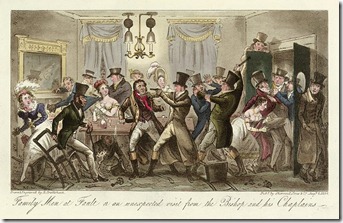
Police reformers, such as John Fielding and Patrick Colquhoun and the commercial and propertied middle-classes increasingly advocated rigorous control and surveillance of the lower classes by a more systematically organised and coordinated police force.[5] Such proposals were vehemently opposed by the gentry and the emerging industrial working-class that feared that the government would form a powerful, centralised police force to ride roughshod over their liberties. With the crucial support of Tory backbenchers, they resisted efforts to establish French-style police methods in England. The most important development was the Middlesex Justices Act of 1792 that appointed stipendiary or paid magistrates in charge of small police forces. But the predominantly local system of policing was still in place in the 1820s.
Crime 27

Sir Robert Peel was responsible for introducing two approaches of policing in Britain. First, when Secretary of State for Ireland between 1812 and 1818, he established the Peace Preservation Force in 1814 and later the Irish Constabulary Act of 1822 established police forces in county areas and created a more militarised and centralised form of policing.[6] This body was a paramilitary police force whose aim was less the detection and prevention of crime than the wider political task of subduing the Catholic Irish peasantry. There was less resistance to stern measures against agrarian protest and violence in Ireland. Secondly, Peel, when Home Secretary after 1822, used arguments based on the efficiency of the Irish police and the threat to liberty from disorder and crime to achieve police reform in England. Peel pushed the Metropolitan Police Act through Parliament in 1829 creating a paid, uniformed, preventive police for London headed by commissioners without magisterial duties and under central direction. The example of uniformed, professional police subsequently spread throughout England over the following decades, but they remained under local control and the extent to which the new police differed from the existing watchmen and constables should not be exaggerated.[7] These developments provided two different models for policing. First, a centralised, military styled and armed force of Ireland kept away from the local community in barracks. Secondly, a consciously non-military, unarmed, preventive English police supposedly working in partnership with and with the consent of the local community.[8] More often than not elements from both models were employed by colonial police forces and adapted to suit local circumstances. Where the security of the state was threatened, the Irish approach was deployed, while English methods were more pervasive and influenced day-to-day policing of all aspects of social life.

During the 1950s and 1960s, historians of English policing argued that the introduction of the ‘new police’ received widespread community support. The few individuals, who opposed its introduction, it was argued, were soon won over by the force’s ability to prevent crime and maintain social order, so securing it ‘the confidence and the lasting admiration of the British people’.[9] The smooth transition from a locally based ‘inefficient’ parish constable system to an efficient and professional body of law enforcers formed the basis of this ‘consensus’ view. During the 1970s, historians using conflict and social control theories challenged the consensus view of widespread public acceptance. Concentrating on working-class responses, they argued that the ‘new police’ were resisted as an instrument of repression developed by the propertied classes. The ‘new police’ were developed to destroy existing working-class culture and impose ‘alien values and an increasingly alien law’ on the urban poor’.[10] Conflict historians argued that a preventive police system was developed in response to changes in the social and economic structure of English society. Robert Storch, its foremost proponent contended that, the formation ‘of the new police was a symptom of both a profound social change and deep rupture in class relations’.[11] The working-class, it was argued, questioned the legitimacy of the ‘new police’ and responded to their interference in a variety of ways ranging from subtle defiance to open and, on occasions, violent resistance.

More recently the level of support that the ‘new police’ received from the propertied classes has been questioned. Barbara Weinberger argues that opposition to the ‘new police’

...was part of a ‘rejectionist’ front ranging from Tory gentry to working class radicals against an increasing number of government measures seeking to regulate and control more and more aspects of productive and social life.[12]

Stanley Palmer also argues that conflict historians ‘have tended to ignore or down play the resistance within the elite to the establishment of a powerful police’ and have over-emphasised the threat from below.[13] While accepting that the introduction of the ‘new police’ involved a clash of moral standards, Palmer argues that it should not be exaggerated.[14] These more recent studies therefore suggest that opposition to the ‘new police’ was also, but not equally, a response of the English upper- and middle-classes.

The broad generalisations regarding public opposition or acceptance of the ‘new police’ have tended to obscure the subtleties in community responses. Opposition did exist, at times resulting from police enforcement of ‘unpopular edicts’ or attempts to ‘prevent mass meetings,’ although they were also used and supported by many people ‘as a fact of life’ in their preventive and social order capacities.[15] While these studies have concentrated predominantly on the public’s negative responses to the introduction of the ‘new police’, Stephen Inwood has considered how the police, administratively and functionally, dealt with the public. Too great a reliance on social control theories, Inwood argues, has led to over-simplification of the complex inter-relationships between the ‘new police’ and the wider community. While the ‘new police’ sought ‘to establish minimum standards of public order,’ it was not in their own interests ‘to provoke social conflict by aspiring to unattainable ideals’.[16] Inwood sees relations between the police and the public as based on a calculated pragmatism in which it was acknowledged that attempts to impose unpopular laws rigidly would ultimately meet with resistance resulting in ‘damage to the rule of law’.[17] Police administrators and the constables were required to tread carefully between the demands and expectations of ‘respectable’ society and the practical need for good relations with the working-class.[18] While there has been a re-examination of public responses to the ‘new police’ and police responses to the public, these studies maintain that the police were, amongst particular groups, for varying reasons and at certain times, unpopular. Weinberger argues that this unpopularity stemmed from public

...suspicion of the police as an alien force outside the control of the community; resentment at police interference in attempting to regulate traditionally sanctioned behaviour; [and] objections to expense.[19]


[1] Lenman, Bruce and Parker, Geoffrey, ‘The State, The Community and Criminal Law in Early Modern Europe’, in Gatrell, V. A. C., Lenman, Bruce and Parker, Geoffrey, (eds.), Crime and the Law: The Social History of Crime in Western Europe Since 1500, (Europa), 1980, pp. 11-48.

[2] Philips, David, ‘‘A New Engine of Power and Authority’: The Institutionalization of Law-Enforcement in England, 1780-1830’, in ibid, Gatrell, V. A. C., Lenman, Bruce and Parker, Geoffrey, (eds.), Crime and the Law: The Social History of Crime in Western Europe Since 1500, pp. 155-189; Hay, Douglas and Snyder, Francis, (eds.), Policing and Prosecution in Britain, 1750-1850, (Clarendon Press), 1989; Emsley, Clive, The English Police: A Political and Social History, 2nd ed., (Longman), 1996, pp. 15-23; McMullan, J. L., ‘The Arresting Eye: Discourse, Surveillance, and Disciplinary Administration in Early English Police Thinking’, Social and Legal Studies, Vol. 7, (1998), pp. 97-128. Gattrell, V., ‘Crime, authority and the policeman-state‘, in ibid, Thompson, F.M.L., (ed.), The Cambridge Social History of Britain 1750-1950: Vol. 3 Social Agencies and Institutions, pp. 243-310 provides a good overview.

[3] Philips, D., ‘‘A New Engine of Power and Authority’ The Institutionalisation of Law Enforcement in England 1750-1830’, in ibid, Gatrell, V. A. C., Lenman, Bruce and Parker, Geoffrey, (eds.), Crime and the Law, p. 126.

[4] ‘Causes of the Increase in Crime’, Blackwood’s Magazine, Vol. 56 (July 1844), p. 8.

[5] See, for example, Colquhoun, P., A Treatise on the Police of the Metropolis, (H. Fry), 1796.

[6] Palmer, S. H., Police and Protest in England and Ireland, 1780-1850, (Cambridge University Press), 1988, chapters 6 and 7.

[7] Styles, John, ‘The Emergence of the Police: Explaining Police Reform in Eighteenth- and Nineteenth-Century England’, British Journal of Criminology, Vol. 27 (1987), pp. 15-22.

[8] Brogden, Michael, ‘An Act to Colonise the Internal Lands of the Island: Empire and the Origins of the Professional Police’, International Journal of the Sociology of Law, Vol. 15, (1987), pp. 179-208; Anderson, D.M. and Killingray, David, (eds.), Policing and the Empire: Government, Authority, and Control, 1830-1940, (Manchester University Press), 1991.

[9] Jones, David, ‘The New Police, Crime and People in England and Wales, 1829-1888,’ Transactions of the Royal Historical Society, Vol. 33, (1983), p. 153. For discussions of this debate see, ibid, Emsley, Clive, Policing and its Context, 1750-1870, pp. 4-7; Bailey, V., ‘Introduction’, in ibid, Bailey, V., (ed.), Policing and Punishment in Nineteenth Century Britain, pp. 12-14; Fyfe, N.R., ‘The Police, Space and Society: The Geography of Policing’, Progress in Human Geography, Vol. 15, (3), (1991), pp. 250-252; ibid, Brogden, M., ‘An Act to Colonise the Internal Lands of the Island: Empire and the Origins of the Professional Police’, pp. 181-183.

[10] Ibid, Jones, David, ‘The New Police, Crime and People in England and Wales, 1829-1888’, p. 153.

[11] Storch, R., ‘The Plague of the Blue Lotus: Police Reform and Popular Resistance in Northern England, 1840-57’, International Review of Social History, Vol. 20, (1975), p. 62.

[12] Weinberger, B., ‘The Police and the Public in Mid-nineteenth-century Warwickshire’, in ibid, Bailey, V., (ed.), Policing and Punishment in Nineteenth Century Britain, p. 66.

[13] Ibid, Storch R., ‘The Plague of the Blue Lotus: Police Reform and Popular Resistance in Northern England, 1840-57’, p. 61; ibid, Palmer S. Police and Protest in England and Ireland, 1780-1850, p. 8.

[14] Storch, R., ‘Policeman as Domestic Missionary: Urban Discipline and Popular Culture in Northern England, 1850-1880’, Journal of Social History, Vol. 9, (4), (1976), pp. 481-509.

[15] Ibid, Jones, David, ‘The New Police, Crime and People in England and Wales, 1829-1888’, p. 166; Ibid, Emsley, Clive, The English Police, pp. 5-6.

[16] Inwood, S., ‘Policing London’s Morals: The Metropolitan Police and Popular Culture, 1829-1850’, London Journal, Vol. 15, (2), (1990), p. 144.

[17] Ibid, Inwood, S., ‘Policing London’s Morals: The Metropolitan Police and Popular Culture, 1829-1850’, p. 134.

[18] Ibid, Inwood, S., ‘Policing London’s Morals: The Metropolitan Police and Popular Culture, 1829-1850’, p. 131

[19] Ibid, Weinberger, B., ‘The Police and the Public in Mid-nineteenth-century Warwickshire’, p. 65.

Friday, 8 April 2011

The problem in policing London to 1829

The traditional view of the system of policing before 1829 was that it was inefficient and corrupt and that the ‘real’ history of policing for London and England begins in 1829. This was certainly the view of contemporary critics such as Patrick Colquhoun but Quarter Session and other local records suggest that to view policing simply from Westminster slanted the issue of law enforcement in the eighteenth and early-nineteenth century unjustifiably in favour of reformers.[1] Although there was ineffective policing before 1829, the same inefficiency was also evident after 1829. Magistrates and local administration in the eighteenth century was not hopelessly ineffective and local leaders were prepared to adopt effective methods of policing. Effective parochial and county administration was pivotal to the implementation of national policies. [2] There was a

significant degree of continuity between the old and the new—the ‘bobbies’ of Scotland Yard carried on what the ‘Charlies’ on the night watch had begun.[3]

The problem of policing was at its most severe in London.[4] The result was the development of professional policing at local level from the initial use of paid watchmen in key West End parishes in 1735 through to the creation of the Metropolitan Police in 1829. By 1823, twenty-three parochial night watch acts has been passed largely before 1790. Even if policing was neither uniform nor centralised over the entire metropolitan area, London was far more extensively policed in 1828 than was the case a century earlier. In 1730, the government decided to appoint a chief magistrate for London to hold court at Bow Street.[5] The first was Sir Thomas de Veil. He was followed by two half brothers, Henry and John Fielding. Henry Fielding had little faith in petty constables or watchmen and he appointed six men to act as full-time ‘runners’ or thief-takers.[6] They were paid a guinea a week plus a share of the reward for each successful prosecution. Later the blind[7] Sir John Fielding, who succeeded his brother, established the Bow Street Runners on a permanent basis and ran it from 1754 to until his death in 1780. The Fieldings transformed the role of the Bow Street magistracy, and provided the model on which the other London Police Offices were based. [8]

The Bow Street Police Office and its personnel have long been regarded by many historians as little more than a discrete and often inconsequential footnote to the history of policing, leading to a partial and incomplete understanding of their work. The term Bow Street ‘Runner’ has caused much subsequent confusion with its frequent misapplication by numerous historians and commentators to the other forces based at Bow Street. These forces included a Foot Patrol, established on a permanent basis in 1790 by Sir Sampson Wright during his tenure as chief magistrate (1780-1797), and operative throughout sixteen districts of central London during the hours of darkness. This force continued in various guises until the advent of the Metropolitan Police in 1829. A Horse Patrol was permanently established in 1805 by Sir Richard Ford (chief magistrate 1800-1806), and this force continued under the aegis of Bow Street Public Office until being finally placed under jurisdiction of the Metropolitan police on 13 August 1836. The Horse Patrol was responsible for patrolling the various turnpiked roads leading into the metropolis. Finally, in 1821 a Day Patrol was created; this force operated in the area of the metropolis between the jurisdiction of the Horse Patrol and the Foot Patrol.[9]  The Thames River Police was set up in 1800 to police the river and its banks.[10]

Crime 26

The Bow Street principal officers were regarded by the Fieldings as more than simply a metropolitan force and they were willing to send the officers throughout Great Britain in order to investigate and detect crimes. Cox argues that in several ways the utilisation of Principal Officers, who alone were originally known as the ‘Bow Street Runners’, in provincially instigated cases paved the way for important subsequent developments in policing, especially with regard to detective practices. The principal officers did operate, on an admittedly small scale, as a de facto national force. Fielding also began a system of publishing information about serious crimes committed in London with descriptions of wanted criminals and in 1772 called for the collection, collation and circulation of information on a national basis. Information was sent to Bow Street from local magistrates and constables and then disseminated throughout Britain by means of the Hue & Cry and Police Gazette, the official publication of Bow Street, founded in 1786 and eventually metamorphosing into the Police Gazette. Bow Street showed that there was an alternative to both the parish constabulary system that was increasingly perceived as outmoded and inefficient and the creation of a large, centralised police force. Much recent research concerning the history of policing has shown that the previously accepted teleological and linear progression from an old inefficient parish and watch system to a efficient and effective ‘modern police’ was not as clear-cut as many police historians of the earlier twentieth century would have had us believe.


[1] For ‘traditional’ teleological accounts of policing history, see Reith, Charles, A Short History of the British Police, (Oxford University Press), 1948, Ascoli, David, The Queen’s Peace: the Origins and Development of the Metropolitan Police 1829-1979, (Hamish Hamilton), 1979, and Critchley, T. A., A History of Police in England and Wales, (Constable), 1978.

[2] See, for example, Kent, Joan R., ‘The centre and the localities: state formation and parish government in England, circa 1640–1740’, Historical Journal, Vol. 38, (1995), pp. 363-404 considers state formation at the base of the governmental system and examines the extent of, and reasons for, support of national policies at the parochial level. See also, Innes, Joanna, Inferior Politics: Social Problems and Social Policies in Eighteenth-Century Britain, (Oxford University Press), 2010 and Davies, Stephen, ‘The Private Provision of Police during the Eighteenth and Nineteenth Centuries’, in Beito, David T., Gordon, Peter and Tabarrok, Alexander, (eds.), The Voluntary City: Choice, Community and Civil Society, (University of Michigan Press), 2002, pp. 151-181.

[3] Ibid, Reynolds, E.A., Before the Bobbies, p. 5, see also, pp. 148-166.

[4] Beattie, J. M., Policing and Punishment in London, 1660–1750: Urban Crime and the Limits of Terror, (Oxford University Press), 2001.

[5] Beattie, J.M. ‘Sir John Fielding and Public Justice: The Bow Street Magistrates’ Court, 1754-1780’, Law and History Review, Vol. 25, (1), (2007), pp. 61-100.

[6] On Henry Fielding see, Fielding, Henry, An Enquiry into the Causes of the late Increase of Robbers, (A. Miller), 1751 and Bertelsen, Lance, Henry Fielding at Work: Magistrate, Businessman, Writer, (Palgrave), 2000.

[7] It was said that Sir John could recognise 3,000 criminals by their voices and that they were unnerved by this talent. There is no modern study of Sir John Fielding but see, Leslie-Melville, R., The Life and Work of Sir John Fielding, (Lincoln Williams), 1905 for useful, if on occasions, anecdotal material.

[8] In 1805 some of the runners were issued with blue coats and trousers, black boots and hats, white gloves and scarlet waistcoats – hence the name ‘Robin Redbreasts’. Each carried a pistol, cutlass and truncheon. See, Cox, David J., A Certain Share of Low Cunning:
A history of the Bow Street Runners, 1792-1839
, (Willan Publishing), 2010 and Beattie, J. M., ‘Early Detection: The Bow Street Runners’, in Emsley. Clive and Shpayer-Makov, Haia, (eds.), Police Detectives in History, 1750–1950, (Ashgate), 2006, pp. 15-32. See also, Hetherington, F.P., Chronicles of Bow Street Police-Office: With an Account of the Magistrates, Runners, and Police, (Chapman & Hall), 1888.

[9] Styles, John, ‘Sir John Fielding and the Problems of Criminal Investigation in Eighteenth-Century England’, Transactions of the Royal Historical Society, Vol. 33, (1983), pp. 127-149 Reynolds, Elaine A., ‘Sir John Fielding, Sir Charles Whitworth, and the Westminster Night Watch Act, 1770-1775’, Criminal Justice History, Vol. 16 (2002).

[10] See, Colquhoun, P., Treatise on the Commerce and Police of the River Thames, (J. Mawman), 1800, pp. 157-208 and Budworth, G., The River Beat: The Story of London’s River Police since 1798, (Historical Publications), 1997.

Development of policing to 1800

The medieval system of policing was based on community action where individuals were expected to aid neighbours and protect their villages from crime.[1] This pledge system was based around tithings, groups of ten families entrusted with policing minor problems such as disturbances, fire, wild animals and other threats. [2] The leader was called a tithingman and he was expected to raise the hue and cry to assemble his followers when the community was threatened and pursue suspected offenders. Ten tithings were grouped into a hundred and the hundredman, who later became the parish constable, dealt with more serious breaches of the law. At county level, the shire reeve, a royal official whose role evolved into that of sheriff, was responsible for public order in his area and soon began to pursue and apprehend criminals as part of his duties.[3] In the thirteenth century, a watch system was developed to protect property in larger towns and cities. Watchmen patrolled at night and helped protect against robberies, disturbances and fire reporting to the area constable.

In 1326, justices of the peace were first appointed to assist the sheriff in controlling the county. Their judicial role developed later in addition to their primary role as peacekeepers.[4] Constables were appointed by Quarter Sessions and became the operational assistant to the justices.[5] Appointed for between three and ten years, the constable faced a heavy fine if he refused to serve. The person appointed constable could pay someone to do the job for him and this became widespread in the sixteenth century and meant that, in some places, almost permanent ‘professionals’ were at work. The constable had to report to JPs on the state of roads and on public houses. He relied on his petty constables, operating in town and village, for his information. The constables had to use their own initiative and make regular presentments (reports) to the court. They had no uniform or weapon. In towns, but also in some villages, watchmen patrolled the streets at night. In London there were also two provost-marshals whose job including arresting vagrants and maintaining order on the highways round the capital.[6]

Maintaining law and order depends on some form of policing. Despite the institutional changes and innovations in procedure which made government in the localities more uniform, more professional and more accountable, by the early-eighteenth century, this system of policing was increasingly unable to cope with the growing population and the rising tide of crime. The only national police force that existed was the revenue or customs officer force that specialised in catching smugglers. The old constable system was cheap to run and the government continued with it. However, it could not cope with the growing size of the new industrial towns like Birmingham, Manchester and Sheffield. What existed was a medieval system of policing in a modern world. Watchmen were poorly paid. Patrick Colquhoun, a critic of the system, argued ‘the old and infirm were thus employed to keep them out of the workhouse’.

Crime 25

Charlie Rouse, London’s last watchman

The City of London employed 1,000 night watchmen so it was an important source of employment. [7] Some watchmen were in league with criminals. They were rarely efficient in dealing with criminals and usually gave up the chase when a criminal went into a neighbouring parish. Some large towns employed thief-takers like Jonathan Wild. They pocketed reward money after the successful prosecution of criminals. Large-scale disturbances or riots were deal with either by the professional army or by the local militia or yeomanry.[8] They were used across England to keep order in the 1790s and 1810s. Local militias were used for local problems but they were often inexperienced and drawn largely from the middle-classes. The Peterloo Massacre of August 1819 shows just how inexperienced they could be.[9]


[1] See Jewell, Helen M., English Local Administration in the Middle Ages, (David and Charles), 1972 for context.

[2] Morris, W.A., The Frankpledge System, (Longman, Green an Co.), 1910, pp. 27-53.

[3] Morris, W.A., The Medieval English Sheriff to 1300, (Manchester University Press), 1927 and Gorski, Richard, The Fourteenth-century Sheriff: English local administration in the late Middle Ages, (Boydell), 2003.

[4] Burn, Richard, The Justice of the Peace and Parish Officer, 3rd ed., (Printed by Henry Lintot for A. Miller), 1756 provides detailed coverage of roles and operation. See also, Osborne, B., Justices of the Peace 1381-1848: A History of the Justices of the Peace for the Counties of England, (Sedgill Press), 1960, Milton, Frank, The English Magistracy, (Oxford University Press), 1967, McConville, S., ‘Frustrated Executives: A Lost Opportunity for the English Magistracy’, Victorian Studies, Vol. 33, (4), (1990), pp. 581-602 and Philips, David, ‘A ‘Weak’ State?: The English State, the Magistracy and the Reform of Policing in the 1830s’, English Historical Review, Vol. 119, (2004), pp. 873-891.

[5] Simpson, H.B., ‘The Office of Constable’, English Historical Review, Vol. 10, (1895), pp. 625-641 is, despite its age, still worth reading. See also, Kent, Joan, ‘The English Village Constable, 1580-1642: The Nature and Dilemmas of the Office’, Journal of British Studies, Vol. 20, (2), (1981), pp. 26-49, Storch, Robert D., ‘The Old English Constabulary’, History Today, Vol. 49, (11), (1999), pp. 43-49.

[6] Boynton, Lindsay, ‘The Tudor Provost-Marshal’, English Historical Review, Vol. 77, (1962), pp. 437-455.

[7] Reynolds, E.A., Before the Bobbies: The Night Watch and Police Reform in Metropolitan London, 1720-1830, (Stanford University Press), 1998.

[8] Dodsworth, FM., ‘The Idea of Police in Eighteenth-Century England: Discipline, Reformation, Superintendence, c. 1780-1800’, Journal of the History of Ideas, Vol. 69, (2008), pp. 583-604 and ‘“Civic” police and the condition of liberty: the rationality of governance in eighteenth-century England’, Social History, Vol. 29, (2004), pp. 199-216.

[9] Paley, Ruth, ‘“An imperfect, inadequate and wretched system”?: policing London before Peel’, Criminal Justice History, Vol. 10, (1989), pp. 95-130. See also, ibid, Dodsworth, F.M., ‘The Idea of Police in Eighteenth-Century England: Discipline, Reformation, Superintendence, c. 1780-1800’.

Monday, 4 April 2011

Young offenders

Juvenile crime was a concern before the beginning of the nineteenth century but a number of historians have argued that the late-eighteenth and early-nineteenth century was pivotal in the changes that occurred in the treatment of juvenile criminals. Some historians argue that this represented an ‘invention’ of juvenile crime but there was not so much an ‘invention’ as a ‘reconceptualisation’ of the juvenile offender during the nineteenth century.[1] Farmers whose apples had been taken may have complained to the children’s parents. The local constable might give them a severe telling off or a clip on the ear. Only the most difficult and persistent child criminals found themselves in court and when they did, they were punished like adults. Children were put in prisons, transported and even hanged. In 1880, there were 6,500 children under 16 in adult prisons, of whom 900 were under 12.[2]

From the late 1810s, commentators were increasingly concerned by juvenile crime and this led to a convergence in policy by public and voluntary sectors. The ideologies of private initiatives set up to deal with juvenile crimes, such as the Marine Society in 1756, the Philanthropic Society in 1788, the Refuge for the Destitute in 1804, not exclusively for juveniles but strongly involved with the rescue and reform of the young and private individuals such as Mary Carpenter, Sydney Turner and Matthew Davenport Hill increasingly coincided with parliamentary penal policy. This fusion in thinking led individuals involved in the voluntary sector became involved in the public machinery of juvenile justice providing evidence to parliamentary committees and commissions.

The publication of the Report of the Committee for Investigating the Alarming Increases of Juvenile Crime in the Metropolis in 1816 was of especial importance. Although many of its arguments having already been presented in the pamphlets of the Philanthropic Society the report seems to have sparked a parliamentary debate about such crime. The Committee that produced it contained a number of Quaker social reformers who were important in the broader history of criminal justice. Thomas Fowell Buxton, an evangelical Whig politician, campaigned for an end to capital punishment in all cases but those of murder. Peter Bedford, the Spitalfields philanthropist was well-known for his work among the deprived silk workers of that area. Samuel Hoare, Quaker banker was Chairman of the Society for the Improvement of Prison Discipline and brother-in-law of Elizabeth Fry and William Crawford, from 1835 one of the first Inspector Generals of Prisons. Quakers put criminals, and particularly women and child criminals, at the heart of political debate promoting a more child-centred approach to juvenile criminals and their role in developing social and domestic policy was pivotal.

Crime 24

The focus for juvenile crime lay in London and the parliamentary debate was coloured by an understanding of metropolitan delinquency. Contemporary reports commented on the swarms of ragged children infesting the metropolis and investigations by social and penal reformers were heavily influenced by a hard-core of juvenile offenders. People’s awareness of juvenile crime was raised by the publication of Oliver Twist in 1837. Dickens shocked people with his description of the Artful Dodger and Fagin’s trained gang of metropolitan pickpockets. His story may have been fiction but it was successful in getting people thinking about child crime and how to deal with it. Discussion of juvenile offenders occurred in other parts of the country but it was rarely as influential as the metropolitan perspective. The factory was increasingly viewed as a site of disorder and delinquency and the work of the Reverend John Clay with prisoners in Preston in the late 1830s and 1840s was widely regarded. [3]

By the 1860s, two alternative views of the nature of juvenile offenders had evolved. The more influential, apparent in the work on delinquents by both Henry Mayhew and John Binny, saw the juvenile criminal as exclusively male.[4] The female role was peripheral and then largely as a source of sexual corruption. Like the Dodger he often had the manner of a small adult, a boy-man, a combination of innocence and experience, of immaturity and mature masculinity that seems to have both disturbed and attracted reformers and investigators. However, there was also an understanding that children were not just miniature adults but developing people who were influenced by their environment. Reformers such as Mary Carpenter, developing the child-centred attitudes of the Friends, began to ask important questions.[5] How and when does a child know what is right and wrong? What should be done about the fact that criminals and deprived backgrounds produced more child criminals?[6] Children were likely to become criminals by sending them to an adult prison.[7] What alternatives should there be?

The result was the gradual development of the juvenile justice system. Though early modern policy makers and welfare practitioners had not been unaware of the specific needs of children, separate institutions for youngsters, both at the level of trial and punishment, were an innovation of the nineteenth century. In 1838, a positive, but short-lived, step was taken of separating juvenile offenders when the former military prison on the Isle of Wight at Parkhurst was opened with a reformatory regime for convicts under eighteen prior to their transportation. The Juvenile Offenders Act of 1847 allowed children under the age of fourteen to be tried summarily before two magistrates, thus making the process of trial for children quicker and removing it from the public glare of the higher courts and the age limit was raised to sixteen in 1850. Acts in 1855, 1879 and 1899 extended summary provision for the young with the result that by 1899; all offences committed by children and young people could be dealt with summarily by magistrates, with the exception of murder charges. In 1853, a Select Committee on Criminal and Destitute Children recommended a degree of state assistance for reformatory schools. The result, between 1854 and 1857, was a series of Reformatory and Industrial School Acts that replaced prison with specific juvenile institutions. The Youthful Offenders Act 1854 provided for persons less than sixteen years to be sent to such schools for from two to five years following two weeks in a prison (perhaps as a shock). These reform schools were very tough but the clear intention was to separate the child from his or her bad home environment. In 1857, legislation sanctioned the sending to industrial schools of children between the ages of seven and fourteen who had been convicted of vagrancy. The perceived decline in juvenile crime after 1860 was often attributed to the reformatories and industrial schools by reformers.[8]

By the late-nineteenth century the new juvenile justice system was firmly in place. Various acts since 1850 had extended summary powers, and there were increasing calls for a separate juvenile court in which to process young delinquents. The first children’s court was set up in Birmingham in April 1905, strongly influenced by the model of the Illinois Juvenile Court that had been established in America in 1899. Transportation had ended by 1867, though emigration of delinquent children continued. A number of Reformatory and Industrial Schools developed from the acts of the 1850s, a process completed by the Education Act of 1876, which put into place industrial day schools and truant schools. In 1902, an experimental school to try to reform repeating offenders aged 15-21 was started at Borstal in Kent. It was run like a public school, with lots of sport and residential houses. The plan for more such schools, called Borstals, was extended in 1908 and for a time they were very successful.

By the 1860s, the state was prepared to intervene directly in the lives of children. The Factory Acts removed children from some workplaces and introduced protections in others; the Education Act 1870 made elementary schooling compulsory. The Children’s Charter of 1889, driven through Parliament by the NSPCC criminalised cruelty to children and enabled the state to intervene in family life. The 1908 Children’s Act was an important move in the separate treatment of children. It stopped children under 14 being sent to prisons and created special Juvenile courts to hear cases. After 1908, a child under seven was not held liable for his actions. This was raised to eight in 1933 and ten in 1963. In 1932, reformatory schools were replaced by Approved Schools for offenders under 15. A total of 86 boys’ schools and 35 girls’ schools were set up. As Radzinowitz and Hood pointed out, by the eve of the First World War, ‘there was a network of 208 schools: 43 reformatories, 132 industrial schools, 21 day industrial schools and 12 truant schools’.[9]

The juvenile offender was not an invention of the nineteenth century. However, it is clear that in this period a reconceptualisation of youth crime, and various developments in social policy, as well as the activities of certain individuals, resulted in a new language of youthful delinquency. By the late-nineteenth century, through a combination of state legislation and institutional projects, voluntary initiatives and cultural concepts culled from a particular response to, and understanding of, such crime, the juvenile offender had become a central figure, fully entrenched in the British justice system.


[1] Shore, Heather, Artful dodgers: youth and crime in early nineteenth-century London, (Royal Historical Society), 1999, Duckworth, Jeannie, Fagin’s Children: Criminal Children in Victorian England, (Hambledon), 2002 and Abbott, Jane, ‘The press and the public visibility of nineteenth-century criminal children’, in ibid, Rowbotham, Judith and Stevenson, Kim, (eds.), Criminal conversations: Victorian crimes, social panic, and moral outrage, pp. 23-39

[2] See, King, Peter and Noel, Joan, ‘The origins of “the problem of juvenile delinquency”: the growth of juvenile prosecutions in London in the late eighteenth and early nineteenth centuries’, Criminal Justice History, Vol. 14, (1993), pp. 17-41, King, Peter, ‘The Rise of Juvenile Delinquency in England, 1780-1840: Changing Patterns of Perception and Persecution’, Past and Present, Vol. 160, (1998), pp. 116-166 and Stack, John A., ‘Children, urbanization and the chances of imprisonment in mid Victorian England’, Criminal Justice History, Vol. 13, (1992), pp. 113-139.

[3] Clay, John, ‘Annual Report of the Rev. John Clay, Chaplain to the Preston House of Correction, Presented to the Visiting Justices at the October Sessions, 1838’, Journal of the Statistical Society of London, Vol. 1, (1839), pp. 84-113. See also, DeLacy, Margaret, Prison reform in Lancashire, 1700-1850: a study in local administration, (Manchester University Press), 1986, pp. 205-224 for discussion of Clay and the separate system.

[4] Ibid, Henry Mayhew and Binny, John, The criminal prisons of London, and scenes of prison life, pp. 376-397.

[5] Carpenter, Mary, Juvenile delinquents: their condition and treatment, (W. & F.G. Cash), 1856, pp. 15-49. She also included a valuable discussion of girls, pp. 81-117.

[6] Ibid, Carpenter, Mary, Juvenile delinquents: their condition and treatment, pp. 119-160.

[7] Ibid, Carpenter, Mary, Juvenile delinquents: their condition and treatment, pp. 161-205.

[8] It is unlikely that this was the only cause of decline and taking the country as a whole there was no common sentencing policy with regard to juveniles. The majority of convicted juveniles continued to be sent to ordinary gaols. See, Shore, Heather, ‘Punishment, Reformation, or Welfare: Responses to ‘The Problem’ of Juvenile Crime in Victorian and Edwardian Britain’, in Johnston, Helen, (ed.), Punishment and control in historical perspective, (Palgrave), 2008, pp. 158-176.

[9] Radzinowicz, Leon and Hood, Roger, The Emergence of Penal Policy in Victorian and Edwardian England, (Oxford University Press), 1990, pp. 618-620.